

Hash vs Rosin vs Flower: Understanding Cannabis Craft
Flower, hash, and rosin represent different expressions of cannabis craft. This guide explains their differences, processes, and what quality really means beyond potency.
Introduction
Cannabis is often discussed in terms of potency or strain names, yet these surface details reveal little about true quality.
At a deeper level, cannabis craft is expressed through form. Flower, hash, and rosin each represent distinct approaches to cultivation, processing, and intent. Understanding these differences is essential for anyone interested in cannabis beyond novelty.
This article explores the characteristics of flower, hash, and rosin — not as products, but as craft disciplines shaped by technique, restraint, and experience.
Cannabis as Craft, Not Commodity
Craft begins where standardization ends.
In responsible cannabis environments, quality is not defined by strength alone. Instead, it reflects:
- Cultivation practices
- Genetic integrity
- Harvest timing
- Processing methods
- Storage and handling
This philosophy aligns closely with how private cannabis clubs operate in Barcelona, where collective responsibility and discretion shape production and distribution, as outlined in How Cannabis Social Clubs Work in Barcelona.
Flower: The Foundation
Flower is the most direct expression of the cannabis plant.
It reflects the entirety of the cultivation process, from genetics to harvest. High-quality flower is defined less by appearance and more by balance.
Key characteristics of premium flower include:
- Intact trichomes
- Preserved terpene profile
- Proper drying and curing
- Natural aroma without artificial enhancement
Flower rewards patience. Its nuances reveal themselves gradually, shaped by aroma, texture, and effect rather than immediate intensity.
What Distinguishes Premium Flower
Not all flower is equal.
Craft-focused cultivation prioritizes:
- Small-batch grows
- Controlled environments
- Genetic preservation
- Minimal mechanical handling
These choices reduce yield but protect integrity. In private cannabis clubs that emphasize quality over volume, flower selection is often intentionally limited — a principle explored further in What Makes a Cannabis Club ‘Premium’?.
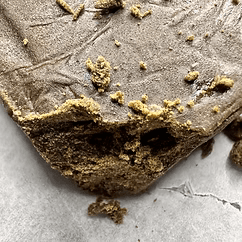
Hash: Tradition and Technique
Hash represents one of the oldest forms of cannabis processing.
Traditionally produced by separating trichomes from plant material, hash reflects both technique and restraint. Its quality depends on:
- Starting material
- Separation method
- Temperature control
- Pressing technique
Well-made hash preserves aromatic compounds while concentrating the plant’s essence. Poorly made hash, by contrast, obscures origin and character.
Types of Hash and Their Intent
While many variations exist, quality-oriented environments often distinguish between:
- Dry sift hash
- Ice water hash
- Hand-pressed traditional styles
Each method reflects a different balance between yield and purity. In craft-focused contexts, purity and texture are valued over quantity.
Hash rewards attention. Texture, aroma, and melt quality often matter more than raw potency.
Rosin: Precision Without Solvents
Rosin is a relatively modern expression of cannabis craft.
Produced by applying heat and pressure to flower or hash, rosin avoids chemical solvents entirely. This process places extreme importance on:
- Input quality
- Temperature control
- Timing
- Post-processing
Because rosin has nowhere to hide flaws, it is often viewed as a test of both material and method.
Why Rosin Is Considered a Craft Benchmark
Rosin’s appeal lies in its transparency.
When executed properly, it preserves:
- Terpene complexity
- Texture integrity
- Clean expression of genetics
This makes rosin particularly valued in environments where intentional consumption matters more than volume — a mindset closely aligned with private, culture-driven cannabis spaces in Barcelona, as discussed in Private Cannabis Clubs vs Weed Tourism in Barcelona.
Comparing Flower, Hash, and Rosin
Rather than ranking these forms, it is more useful to understand their roles.
- Flower expresses cultivation
- Hash expresses tradition and separation
- Rosin expresses precision and restraint
Each appeals to different preferences, contexts, and moments. None exists to replace the others.
In quality-focused settings, these forms often coexist, offering varied expressions of the same underlying philosophy.
Texture, Aroma, and Experience
True quality reveals itself through sensory detail.
Craft-oriented evaluation considers:
- Aroma clarity
- Texture consistency
- Clean finish
- Absence of harshness
These elements are difficult to quantify but easy to recognize with experience. They reward slower, more attentive engagement.
This sensory emphasis parallels the broader cultural values found in Barcelona’s cannabis ecosystem, explored in Cannabis Culture in Barcelona: Beyond Clubs.
Why Potency Is a Poor Metric
Potency dominates marketing because it is easy to measure.
Craft prioritizes what is harder to quantify: balance, expression, and intention. High potency does not guarantee quality, and in many cases, excessive strength undermines experience.
Responsible cannabis environments emphasize moderation, context, and awareness — principles that align closely with private association models rather than tourist-oriented consumption.
Craft Requires Restraint
Every stage of cannabis craft involves choices.
Choosing to harvest later or earlier. Choosing to process gently rather than aggressively. Choosing consistency over yield.
These decisions define quality far more than novelty or scale.
In environments that value longevity and discretion, restraint becomes a defining feature — not a limitation.
Final Thoughts
Flower, hash, and rosin are not competitors. They are expressions of intent.
Understanding cannabis craft requires looking beyond surface metrics and appreciating the disciplines behind each form. In Barcelona’s private cannabis culture, this understanding is shared quietly among those who value quality, context, and continuity.
Craft, here, is not a trend. It is a practice refined over time.